



LOCTITE 221 - 50ml (produkt anaerobowy do zabezpieczania połączeń gwintowych, łatwo demontowalny, fioletowy / anaerobic, violet, low strength threadlocker)
Nr
IDH.135331
LOCTITE 221 - 50ml (produkt anaerobowy do zabezpieczania połączeń gwintowych, łatwo demontowalny, fioletowy / anaerobic, violet, low strength threadlocker)
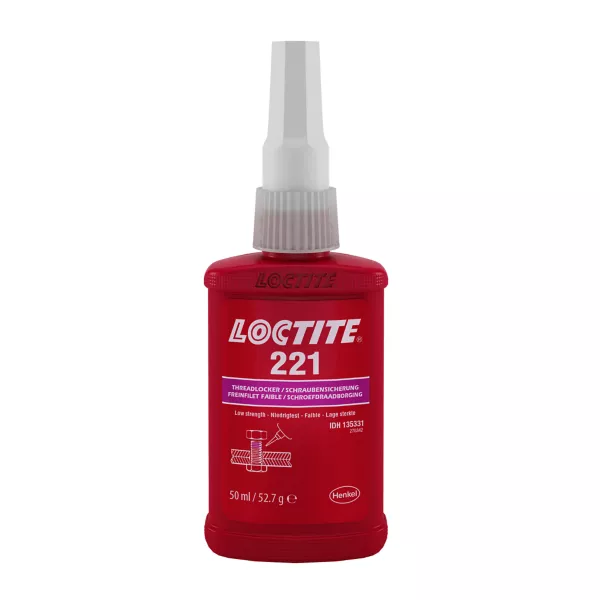
LOCTITE® 221™ – Klej do gwintów o niskiej wytrzymałości
| 1. Opis techniczny | |
|---|---|
| Technologia / Baza chemiczna | Akryl / Ester dimetakrylanu |
| Zastosowanie / Wytrzymałość | Zabezpieczanie połączeń gwintowych (Threadlocking) / Niska wytrzymałość |
| Charakterystyka procesu | Produkt jednoskładnikowy – nie wymaga mieszania. Utwardzanie beztlenowe (anaerobowe) zachodzące po odcięciu dostępu powietrza w szczelinie pomiędzy ściśle przylegającymi metalowymi powierzchniami. Zapobiega samoczynnemu luzowaniu i powstawaniu nieszczelności pod wpływem wstrząsów i wibracji. Cechuje się niską lepkością ułatwiającą penetrację drobnych gwintów. Umożliwia łatwy demontaż przy użyciu standardowych narzędzi ręcznych bez ryzyka ukręcenia śruby. |
| 2. Aplikacje i typowe branże | |
| Przeznaczenie przemysłowe | Blokowanie i uszczelnianie złączy gwintowych wymagających łatwego demontażu standardowymi narzędziami ręcznymi. |
| Typowe obszary zastosowań | Śruby regulacyjne, nastawcze i dociskowe, połączenia o małych średnicach gwintu lub o dużej długości zwoju, gdzie wymagany jest demontaż bez ścięcia śruby. Powszechnie stosowany w mechanice precyzyjnej, przyrządach pomiarowych, elektronice i optyce. |
| 3. Instrukcja krok po kroku | |
| 1. Odtłuszczenie i przygotowanie: W celu uzyskania optymalnych rezultatów oczyścić i odtłuścić wszystkie powierzchnie (zewnętrzne i wewnętrzne) zmywaczem LOCTITE® i pozostawić do wyschnięcia. 2. Aktywacja (opcjonalnie): W przypadku metali nieaktywnych lub zbyt wolnego tempa polimeryzacji nanieść na zwoje aktywator (np. LOCTITE® SF 7471 lub SF 7649) i odczekać do odparowania. 3. Wstrząśnięcie butelki: Dokładnie wstrząsnąć opakowanie przed użyciem. Aby uniknąć zatykania się dyszy, nie dopuszczać do bezpośredniego kontaktu końcówki aplikatora z powierzchnią metalu. 4. Aplikacja produktu: • Otwory przelotowe: Nanieść kilka kropel produktu na śrubę w strefie kontaktu z nakrętką. • Otwory ślepe: Nanieść kilka kropel na dolną 1/3 gwintu wewnętrznego lub bezpośrednio na dno otworu. • Uszczelnianie złączy gwintowych: Nałożyć kroplę w obwodzie 360° na początkowe zwoje gwintu zewnętrznego, pozostawiając pierwszy zwój wolny. Wprowadzić klej w zwoje tak, aby dokładnie wypełnić szczeliny. 5. Montaż i dociągnięcie: Zmontować połączenie i dokręcić zgodnie z wymaganym momentem montażowym. 6. Demontaż i usuwanie pozostałości: Rozłączyć połączenie za pomocą standardowych narzędzi ręcznych. W rzadkich przypadkach (bardzo długa linia styku gwintu) podgrzać lokalnie nakrętkę lub śrubę do ok. +250°C i demontować na gorąco. Utwardzony klej usunąć przez namoczenie w zmywaczu LOCTITE® i obróbkę mechaniczną szczotką drucianą. | |
| 4. Główne zalety i parametry kluczowe | |
| Zakres temperatur pracy | -55°C do +150°C (wytrzymałość termiczna i starzenie badane w TDS do +150°C) |
| Czas ustalania na stali (22°C) | Ok. 25 min (początek wiązania), ok. 6 h do uzyskania pełnej wytrzymałości wg krzywej TDS |
| Czas pełnego utwardzenia | 24 h (do 72 h w zależności od szczeliny i materiału złącza) |
| Maksymalna szczelina wypełnienia | Do 0,25 mm (wg krzywej ISO 10123) |
| Fluorescencja | Dodatnia w świetle UV |
| 5. Pełne parametry fizykochemiczne i wytrzymałościowe | |
| Właściwości materiału nieutwardzonego (25°C) | |
| Wygląd (postać nieutwardzona) | Fioletowa ciecz (Purple liquid) |
| Ciężar właściwy / Gęstość w 25°C | 1,05 g/cm³ |
| Temperatura zapłonu | Patrz Karta Charakterystyki (SDS) |
| Lepkość, Brookfield – RVT (25°C, wrzeciono 1, 20 obr./min) | 100 mPa·s do 150 mPa·s (cP) |
| Właściwości termiczne materiału utwardzonego | |
| Współczynnik rozszerzalności cieplnej, ISO 11359-2 | 100×10⁻⁶ K⁻¹ |
| Współczynnik przewodzenia ciepła, ISO 8302 | 0,1 W/(m·K) |
| Ciepło właściwe | 0,3 kJ/(kg·K) |
| Właściwości mechaniczne i wytrzymałościowe (utwardzanie 24 h @ 22°C) | |
| Moment zerwania (Breakaway torque), ISO 10964, bez wstępnego dokręcenia | Śruby i nakrętki stalowe M10: 5 N·m do 12 N·m (40 lb·in do 110 lb·in) |
| Moment przeważający (Prevail torque), ISO 10964, bez wstępnego dokręcenia | Śruby i nakrętki stalowe M10: 2 N·m do 8 N·m (20 lb·in do 70 lb·in) |
| Moment odkręcania (Breakloose torque), ISO 10964, wstępnie dociągnięte do 5 N·m | Śruby i nakrętki stalowe M10: 9 N·m do 21 N·m (80 lb·in do 90 lb·in) |
| Maksymalny moment przeważający (Max. Prevail torque), ISO 10964, wstępnie dociągnięte do 5 N·m | Śruby i nakrętki stalowe 3/8 × 16: 9 N·m do 21 N·m (80 lb·in do 90 lb·in) |
| Wytrzymałość na ścinanie (Compressive Shear Strength), ISO 10123 | Sworznie i tuleje stalowe: 3 N/mm² do 10 N/mm² (430 psi do 1 450 psi) |
| Wytrzymałość po 1 tygodniu utwardzania w 22°C (wstępne dociągnięcie do 5 N·m) | |
| Moment odkręcania (Breakloose torque), ISO 10964 – stal nierdzewna M10 | Brak danych w TDS |
| Odporność chemiczna i środowiskowa (starzenie i badanie w 22°C) | |
| Olej silnikowy MIL-L-46152 (starzenie w 125°C) | 100% pierwotnej wytrzymałości po 100 h | 95% po 500 h | 95% po 1 000 h |
| Benzyna bezołowiowa (22°C) | 95% po 100 h | 95% po 500 h | 95% po 1 000 h |
| Płyn hamulcowy (22°C) | 95% po 100 h | 95% po 500 h | 90% po 1 000 h |
| Mieszanina wody i glikolu 50/50 (starzenie w 87°C) | 80% po 100 h | 80% po 500 h | 80% po 1 000 h |
| Aceton (22°C) | 100% po 100 h | 90% po 500 h | 90% po 1 000 h |
| Etanol (22°C) | 95% po 100 h | 95% po 500 h | 90% po 1 000 h |
| Warunki przechowywania | Przechowywać w suchym miejscu w nieotwieranym pojemniku w optymalnej temperaturze od +8°C do +21°C. Przechowywanie poniżej +8°C lub powyżej +28°C może negatywnie wpłynąć na parametry produktu. Nie wlewać resztek kleju z powrotem do butelki. |
LOCTITE® 221™ – Low Strength Threadlocker
| 1. Product Description | |
|---|---|
| Technology / Chemical Type | Acrylic / Dimethacrylate ester |
| Application / Strength | Threadlocking / Low strength |
| Process Characteristics | One component – requires no mixing. Anaerobic cure when confined in the absence of air between close-fitting metal surfaces. Prevents loosening and leakage from shock and vibration. Features low viscosity to penetrate fine pitch threads. Allows easy disassembly using standard hand tools without shearing the fastener. |
| 2. Applications | |
| Industrial Intended Use | Locking and sealing of threaded fasteners which require normal disassembly with standard hand tools. |
| Typical Equipment Areas | Adjustment of set screws, calibration screws, small diameter fasteners, or assemblies with long engagement lengths where effortless disassembly without damage is essential. Suitable for instrumentation, electronics, precision engineering, and optics. |
| 3. Directions for Use | |
| 1. Cleaning & Degreasing: For best results, clean all surfaces (external and internal) with a LOCTITE® cleaning solvent and allow to dry thoroughly. 2. Activation (optional): If the material is an inactive metal or cure speed is too slow, spray all threads with Activator (e.g. LOCTITE® SF 7471 or SF 7649) and allow to dry. 3. Shake Container: Shake the product thoroughly before use. To prevent product from clogging in the nozzle, do not allow the tip to touch metal surfaces during application. 4. Product Application: • Thru Holes: Apply several drops of the product onto the bolt at the nut engagement area. • Blind Holes: Apply several drops of product to the lower third of the internal threads, or the bottom of the blind hole. • Sealing Applications: Apply a 360° bead of product to the leading threads of the male fitting, leaving the first thread free. Force the material into threads to fill all voids. 5. Assembly & Tightening: Assemble fasteners and tighten as required according to specifications. 6. Disassembly & Clean-up: Remove with standard hand tools. In rare instances where hand tools do not work due to excessive engagement length, apply localized heat (approx. +250°C) to nut or bolt and disassemble while hot. Remove cured adhesive by soaking in LOCTITE® solvent combined with mechanical abrasion (wire brush). | |
| 4. Key Properties | |
| Service Temperature Range | -55°C to +150°C (hot strength and heat aging tested up to +150°C) |
| Fixture Time on Steel (22°C) | Approx. 25 min (cure onset), approx. 6 h to full functional strength per TDS cure graph |
| Full Cure Time | 24 h (up to 72 h depending on substrate and gap) |
| Max Diametral Clearance / Bond Gap | Up to 0.25 mm (tested per ISO 10123) |
| Fluorescence | Positive under UV light |
| 5. Technical Specifications | |
| Uncured Material Properties (@ 25°C) | |
| Appearance (uncured) | Purple liquid |
| Specific Gravity @ 25°C | 1.05 |
| Flash Point | See Safety Data Sheet (SDS) |
| Viscosity, Brookfield – RVT (25°C, Spindle 1, 20 rpm) | 100 mPa·s to 150 mPa·s (cP) |
| Thermal Properties of Cured Material | |
| Coefficient of Thermal Expansion, ISO 11359-2 | 100×10⁻⁶ K⁻¹ |
| Coefficient of Thermal Conductivity, ISO 8302 | 0.1 W/(m·K) |
| Specific Heat | 0.3 kJ/(kg·K) |
| Adhesive Properties – ISO 10964 (Cured 24 h @ 22°C) | |
| Breakaway Torque, Unseated | M10 steel nuts and bolts: 5 N·m to 12 N·m (40 lb·in to 110 lb·in) |
| Prevailing Torque, Unseated | M10 steel nuts and bolts: 2 N·m to 8 N·m (20 lb·in to 70 lb·in) |
| Breakloose Torque, Pre-torqued to 5 N·m | M10 steel nuts and bolts: 9 N·m to 21 N·m (80 lb·in to 90 lb·in) |
| Max. Prevailing Torque, Pre-torqued to 5 N·m | 3/8 × 16 steel nuts and bolts: 9 N·m to 21 N·m (80 lb·in to 90 lb·in) |
| Compressive Shear Strength, ISO 10123 | Steel pins and collars: 3 N/mm² to 10 N/mm² (430 psi to 1,450 psi) |
| Cured for 1 week @ 22°C (Pre-torqued to 5 N·m) | |
| Breakloose Torque, ISO 10964 – M10 stainless steel | Not specified in TDS |
| Chemical / Solvent Resistance (Aged under conditions, tested @ 22°C) | |
| Motor oil MIL-L-46152 (Aged @ 125°C) | 100% initial strength @ 100 h | 95% @ 500 h | 95% @ 1,000 h |
| Unleaded gasoline (@ 22°C) | 95% @ 100 h | 95% @ 500 h | 95% @ 1,000 h |
| Brake fluid (@ 22°C) | 95% @ 100 h | 95% @ 500 h | 90% @ 1,000 h |
| Water/glycol 50/50 (Aged @ 87°C) | 80% @ 100 h | 80% @ 500 h | 80% @ 1,000 h |
| Acetone (@ 22°C) | 100% @ 100 h | 90% @ 500 h | 90% @ 1,000 h |
| Ethanol (@ 22°C) | 95% @ 100 h | 95% @ 500 h | 90% @ 1,000 h |
| Storage Conditions | Store product in unopened container in a dry location. Optimal storage: 8°C to 21°C. Storage below 8°C or greater than 28°C can adversely affect product properties. Do not return unused adhesive to original container. |
LOCTITE® 221™ – Niedrigfeste Schraubensicherung
| 1. Produktbeschreibung | |
|---|---|
| Technologie / Chemische Basis | Acrylat / Dimethacrylatester |
| Anwendungsbereich / Festigkeit | Gewindesicherung (Threadlocking) / Niedrigfest |
| Prozessmerkmale | Einkomponentig – kein Mischen erforderlich. Härtet unter Luftabschluss (anaerob) zwischen enganliegenden metallischen Flächen aus. Verhindert zuverlässig das Losdrehen und Leckagen durch Stoßbelastungen und Vibrationen. Niedrigviskos, dadurch hervorragend geeignet für feine Gewindegänge. Ermöglicht einfache Demontage mit normalem Handwerkzeug ohne Abscheren der Schrauben. |
| 2. Anwendungsbereiche | |
| Industrielle Bestimmung | Sichern und Dichten von Gewindeverbindungen, die mit normalem Handwerkzeug demontierbar sein müssen. |
| Typische Einsatzgebiete | Justierschrauben, Madenschrauben, Verbindungselemente mit kleinem Gewindedurchmesser oder langen Gewindeeingriffslängen, bei denen eine einfache Demontage ohne Zerstörung erforderlich ist. Häufig eingesetzt im Feingerätebau, in der Mess- und Regeltechnik, Elektronik sowie Optik. |
| 3. Gebrauchsanweisung | |
| 1. Reinigen & Entfetten: Für beste Ergebnisse alle Oberflächen (innen und außen) mit einem LOCTITE® Reiniger reinigen und trocknen lassen. 2. Aktivierung (optional): Bei passiven Metallen oder zu langsamer Aushärtung alle Gewinde mit Aktivator (z. B. LOCTITE® SF 7471 oder SF 7649) benetzen und ablüften lassen. 3. Schütteln: Flasche vor Gebrauch gründlich schütteln. Dosierspitze nicht mit Metall in Kontakt bringen, um ein Verstopfen der Spitze zu verhindern. 4. Produktauftrag: • Durchgangsbohrungen: Einige Tropfen des Produkts im Gewindeeingriffsbereich auf die Schraube applizieren. • Sacklochbohrungen: Einige Tropfen in das untere Drittel des Innengewindes oder auf den Grund der Sacklochbohrung geben. • Dichtanwendungen: Klebstoff als 360°-Raupe auf das Außengewinde auftragen, den ersten Gewindegang freilassen. Produkt in das Gewinde drücken, um Hohlräume vollständig zu füllen. 5. Montage & Anziehen: Schrauben wie konstruktiv vorgegeben montieren und anziehen. 6. Demontage & Reinigung: Mit normalem Handwerkzeug lösen. In seltenen Fällen (z. B. lange Gewindeeingriffe) die Verbindung lokal auf ca. +250°C erwärmen und heiß demontieren. Ausgehärteten Klebstoff durch Einweichen in LOCTITE® Lösungsmittel und Abbürsten mit Drahtbürste entfernen. | |
| 4. Haupteigenschaften | |
| Einsatztemperaturbereich | -55°C bis +150°C (Warmfestigkeit und Wärmealterung im TDS bis +150°C geprüft) |
| Handfestigkeit auf Stahl (22°C) | Ca. 25 min (Festigkeitsbeginn), ca. 6 h bis zur vollen Funktionsfestigkeit gemäß TDS-Diagramm |
| Endfestigkeit | 24 h (bis zu 72 h abhängig von Werkstoff und Spaltbreite) |
| Maximales Spaltmaß | Bis 0,25 mm (nach ISO 10123 geprüft) |
| Fluoreszenz | Positiv unter UV-Licht |
| 5. Detaillierte technische Daten | |
| Eigenschaften des flüssigen Materials (@ 25°C) | |
| Aussehen (ungehärtet) | Lila Flüssigkeit (Purple liquid) |
| Spezifisches Gewicht / Dichte @ 25°C | 1,05 g/cm³ |
| Flammpunkt | Siehe Sicherheitsdatenblatt (SDB) |
| Viskosität, Brookfield – RVT (25°C, Spindel 1, 20 U/min) | 100 mPa·s bis 150 mPa·s (cP) |
| Thermische Eigenschaften des ausgehärteten Materials | |
| Thermischer Ausdehnungskoeffizient, ISO 11359-2 | 100×10⁻⁶ K⁻¹ |
| Wärmeleitfähigkeit, ISO 8302 | 0,1 W/(m·K) |
| Spezifische Wärmekapazität | 0,3 kJ/(kg·K) |
| Festigkeitseigenschaften – ISO 10964 (Ausgehärtet 24 h @ 22°C) | |
| Losbrechmoment (Breakaway torque), ungespannt | M10 Stahlschrauben und -muttern: 5 N·m bis 12 N·m (40 lb·in bis 110 lb·in) |
| Weiterdrehmoment (Prevailing torque), ungespannt | M10 Stahlschrauben und -muttern: 2 N·m bis 8 N·m (20 lb·in bis 70 lb·in) |
| Ausschraubmoment (Breakloose torque), mit 5 N·m vorgespannt | M10 Stahlschrauben und -muttern: 9 N·m bis 21 N·m (80 lb·in bis 90 lb·in) |
| Max. Weiterdrehmoment (Max. Prevailing torque), mit 5 N·m vorgespannt | 3/8 × 16 Stahlschrauben und -muttern: 9 N·m bis 21 N·m (80 lb·in bis 90 lb·in) |
| Druckscherfestigkeit (Compressive Shear Strength), ISO 10123 | Stahlbolzen und -buchsen: 3 N/mm² bis 10 N/mm² (430 psi bis 1.450 psi) |
| Ausgehärtet für 1 Woche @ 22°C (mit 5 N·m vorgespannt) | |
| Ausschraubmoment (Breakloose torque), ISO 10964 – M10 Edelstahl | Keine Angabe im TDS |
| Chemikalien- / Lösemittelbeständigkeit (Gelagert und geprüft @ 22°C) | |
| Motoröl MIL-L-46152 (Gelagert @ 125°C) | 100% Anfangsfestigkeit nach 100 h | 95% nach 500 h | 95% nach 1.000 h |
| Bleifreies Benzin (@ 22°C) | 95% nach 100 h | 95% nach 500 h | 95% nach 1.000 h |
| Bremsflüssigkeit (@ 22°C) | 95% nach 100 h | 95% nach 500 h | 90% nach 1.000 h |
| Wasser/Glykol 50/50 (Gelagert @ 87°C) | 80% nach 100 h | 80% nach 500 h | 80% nach 1.000 h |
| Aceton (@ 22°C) | 100% nach 100 h | 90% nach 500 h | 90% nach 1.000 h |
| Ethanol (@ 22°C) | 95% nach 100 h | 95% nach 500 h | 90% nach 1.000 h |
| Lagerungsbedingungen | Im ungeöffneten Originalgebinde an einem trockenen Ort aufbewahren. Optimale Lagertemperatur: 8°C bis 21°C. Eine Lagerung unter 8°C oder über 28°C kann die Produkteigenschaften beeinträchtigen. Einmal entnommenes Produkt niemals in das Originalgebinde zurückgießen. |
